

How To Fix A Frost Heave Deck Post
1 of the most common problems with decks in Minnesota is frost heave. Today I'll explain how this works, why it matters, and what steps tin can be taken to help forbid impairment from frost boost when building a deck.
How Frost Heave Works
When expansive soils freeze and expand, the earth rises. Wikipedia has a nice illustration of how this works, shown below.
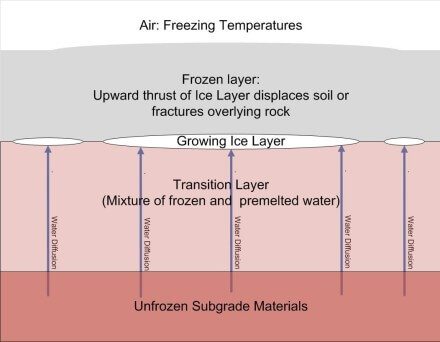
How much can soils heave? It depends. I one time lived in a townhouse in Saint Louis Park with a patio that would heave about four" during the winter; it got and then bad that I could barely open my storm door during the winter.
Harm Caused by Frost Heave
Without a doubt, some of the worst frost heave I've come across has been here in Maple Grove. The photograph beneath shows a Maple Grove deck that nosotros recently inspected in the middle of an Apr snow storm. The right side had obviously heaved several inches. Click on the photograph for a larger view.
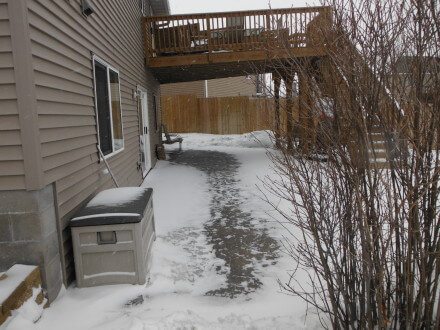
The deck shown below had severe frost heave in the heart and confronting the business firm, and had to be completely torn downwards and rebuilt because the deck was so severely heaved in the middle.
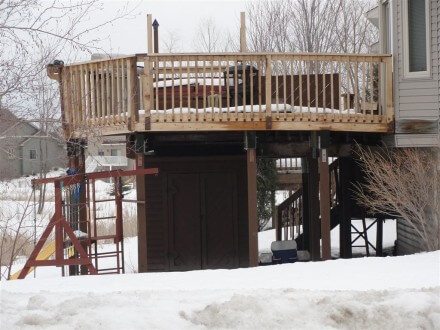
Here'southward one more photo showing major frost boost at a deck.
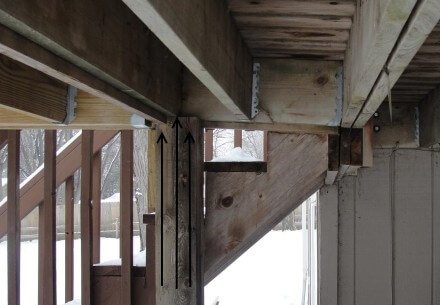
How Deck Footings Boost
When a deck is attached to a edifice, the role of the deck that gets supported by the earth needs to have proper frost footings. The most common deck footing is basically a large chunk of concrete poured in to a hole in the world. The goal is to accept this chunk of concrete go deep plenty in to the basis then that the bottom rests on soils that never freeze, which should foreclose the soils from pushing the ground upwardly.
When deck footings aren't poured deep enough, decks can heave. Sandy, well drained soils aren't particular susceptible to frost heave, while soils with higher clay content are prone to frost heave. This is why it's so important for deck footings to extend downwards below the frost line.
Preventing Frost Heave
How deep practice footings need to exist to preclude frost heave? There's no magic number. When there is a lot of snow on the basis, the snow acts like a layer of insulation and reduces the frost depth. When it's a winter with very trivial snowfall, similar the blazon Minnesota experienced in 2011-2012, the frost depth will be much deeper than usual. Outdoor temperatures plainly make a difference, then does proximity to water. Decks constructed near wetlands will have an increased potential for frost heave.
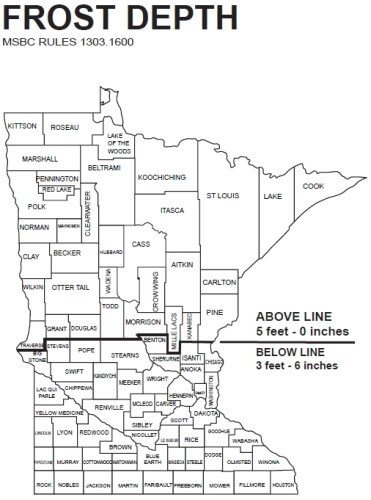
The Minnesota State Building Code requires footings to be a minimum of 42" deep in the southern function of the state, and a minimum of lx" deep in the northern role of the state. The diagram below shows the dividing line.
While footings need to be deep enough in the soil to preclude frost boost, the depth of the basis is only one part of the equation. No affair how deep the ground is, if the surrounding soils expand plenty to 'take hold of on' to the concrete footing, the surrounding soils can pull footings up out of the ground.
One pace that can be taken to help foreclose soils from grabbing on to the footing is to apply waxed cardboard tubes for the footings, often referred to every bit sonotubes. The Family Handyman spider web site has a great cutaway photo of a footing with one of these tubes, used with permission below.
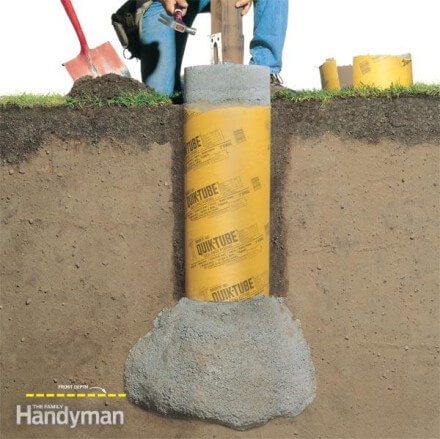
Another step to forestall heaved footings is to 'bell' out the bottom of the footing, equally shown in the photo above. The 'bell' shape at the bottom prevents soils from pushing the footing up and out, but information technology can also pb to a fractured basis. When expansive soils take hold of on to the walls of a footing and pull information technology up, the bell at the lesser will agree the footing in identify until the force per unit area exerted by the frost exceeds the tensile strength of the concrete. Once that happens, the footing will simply intermission in one-half.
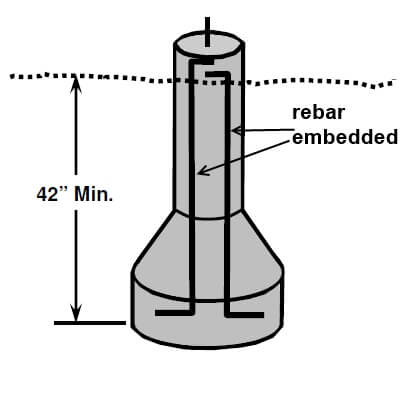
When you consider the relatively low tensile forcefulness of concrete and the tremendous corporeality of force exerted by frost, it's easy to understand how pier footings can intermission. One step that tin be taken to assistance prevent this is to use rebar inside the footings. The diagram beneath, courtesy of the City of Maple Grove, shows a deck basis with rebar embedded to aid prevent the ground from breaking.
Adjacent week I'll have a follow-upwardly post on a newer style of ground for decks that might just be the side by side big thing, called Diamond Pier® Footings.
Author: Reuben Saltzman, Structure Tech Home Inspections



How To Fix A Frost Heave Deck Post,
Source: https://structuretech.com/frost-heave-and-deck-footings/
Posted by: lemendessaimis35.blogspot.com
0 Response to "How To Fix A Frost Heave Deck Post"
Post a Comment