

How To Fix Fuse In Z-5500 Digital Logitech Without The That Screws On Fuse
Logitech Z-5500 Digital 5.i Speaker Organization Modding
This keen speaker system brought many happy hours for its owners since its appearance and information technology's still very popular. A prissy combination of decent sound quality with an affordable price tag. After years of active friendship we may fell the need for something more avant-garde, when nosotros realise almost noting left to proceeds using the latest audio cards with the organization. Practiced to know that our beloved ane has a second risk to remain as a companion in the coming years.
Probably many people tried to employ higher quality wires for the speakers or even change them to something better to improve the sound. From the audiophile betoken of view, at that place is much more than to exist done in the inside of the system than you would call back at first. One reason is the age of the pattern the other is the cost constructive, low-end components. I'm sure in that location are many who is not familiar what can be done in the within, so I started this thread for those. There is no new discovery hither, and I take zero to offer for experts or rocket scientists.

Thanks to my relatives I had the opportunity to examine the systems (because I do not take one) and figure out how to improve its audio quality beyond the original. On the end of the modding they take concluded the effort well worth it. Of course the design holds many limits and opportunities, and I tried to focus on what is supposed to be a adept investment. With some skill of soldering and some know-how you can upgrade your favourite to a much better one and enjoy the great taste of modding. I try to provide all the details and share what I've learned to make it easy for anybody who get the inspiration to effort it.
Please recollect, modifications most certainly void the warranty and aren't take chances gratis, mistakes are role of homo nature. If you want to be very sure nothing goes wrong during the upgrade, it'south wise to let an practiced to exercise the task for you lot.
First things first. If you are using your speaker organization connected to the integrated sound card past analog or digital connectedness, I suggest leaving this upgrade for later. As nosotros experienced the defended higher quality cards are noticeably handle both tasks better.
From the Analog VS Digital input comparison the analog is the winner with the Z-5500. This is getting more interesting if yous are familiar with the fact, the analog signal first digitalized in the command pod, than converted back to analog after processing.
You may need:
glue gun
Phillips screwdrivers
magnifying glass
stain remover or alcohol and cotton fiber buds (to clean off soldering paste)
modest size players
2A ho-hum-blow fuses (just in case)
thermal paste (nothing exotic)
few female spiral 3M or commodities cutter
solder (good quality suitable for smd)
tweezers (to hold a scrap comfortably)
soldering paste or flux (essential for soldering fries)
soldering iron (for the OpAmps upwards to 30W, and a little more than for desoldering coming handy)
or
temperature controlled soldering station
steel scrubber (new from the kitchen to the soldering tip go along clean)
wire (between the caps and PCB)
Capacitors for the amplifier and preamplifier panel:
12 pcs 220nF 63V or 100V MKT film capacitors Wima, Philips, ERO, etc. (optional)
7 pcs 220nF 63V or 100V axial film capacitors (polystyrene, MKP films or Sovjet K73-sixteen)
2 pcs 1uF 63V MKT film (optional)
13 pcs 22uF 50V Elna Silmic Ii (or Silmic, Cerafine, Tonerex or Nichicon: KZ, FG)
1 x 10uF 50V (aforementioned)
12pcs 47UF 50V (aforementioned but only 6 pcs for the third Mod)
Control panel:
analog input
half-dozen pcs 47uF 25V Elna Silmic II (or Silmic, Cerafine, Tonerex or Nichicon FG)
half-dozen pcs 10uF 16V Elna Silmic Ii or Tonerex 10uf 50V (not much space available)
analog output
6 pcs 47uF 25V Elna Silmic 2(or Silmic, Cerafine, Tonerex or Nichicon FG)
6 pcs 22uF 16V (same)
book controll
2 pcs 10uF 16V (same)
1 pcs 47uF 16V Sanyo Bone-Con (or the others abowe)
Main filter capacitors:
2 pcs 50V 10000uF Elna: Denon, Elna for Audio or Nichicon: KG, KW, FW
1 pcs 4700uF Elna: Kenwood 75V or Nichicon: KG, KW, FW
(The advantage of the nichicon KW and FW is the small size)
Operational Amplifiers:
11 pcs OPA1602AID or OPA1612AID (5pcs the minimum recommended, but if you working on the third Mod purchase simply 2 pcs, plus 5pcs 0.47uF 63V axial pic capacitors)
A practical source of the components is eBay. The anticipated cost is starting from seventy€ for a full mod, and the surplus quantities you lot have to purchase from components, are not part of my estimation.
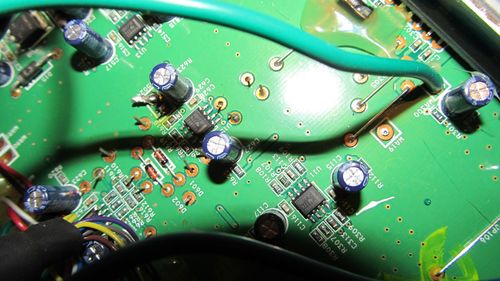
Operational amplifiers (OpAmp):
The entire speaker organisation has xi pieces. There are vi in the control console, and the remaining five what I recommend equally priority to replace in the box of the subwoofer. The replacement of OpAmps usually means the main cure for the poor audio for many sound systems. Other than soldering, this is a relatively simple task considering there is easy access to them. Perhaps the simplest manner to remove the stock OpAmps is to cut beyond the pins one after another than clean of what is left on the PCB with a soldering iron. Cutting multiple pins in the same time is an unnecessary take a chance to take and piece of cake to end up pulling off the pads from the board, than you lot have a problem to solve.
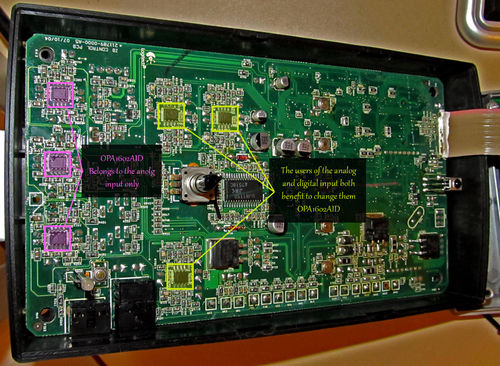
The way I like to do desoldering is:
- add together plenty soldering paste over the chip
- solder the pins together both sides
- oestrus the sides quick (480°C or 896°F) meanwhile pushing a small screwdriver under it gently, most no pressure applied
- lift one side a fleck than the other until the original soldering isn't not holding any more
- switch to the tweezers and lift off the bit
- cleaning off all the solder
- cleaning off all the soldering paste using spirit and cotton buds
Done!
The soldering:
- use enough of fresh soldering paste on the board
- stick the chip to the paste and recheck alignment
- hold it with the tweezers and solder 1 pivot in a corner
- make a bit of correction if the flake is moved, than solder some other pin on the opposite side
- add more paste over the pins if necessary
- solder the pins one after some other
- clean of the paste
- check connections using magnifying glass, or better with the diode tester (one pin directly well-nigh the fleck body, meanwhile using the other to find connexion on the nearably SMD components.)
Done!
I really love Texas Instruments Operational Amplifiers in general. The stock R4580I conspicuously not belong to that group, because the less you have from them, the better the sound you become, so it's ameliorate to go rid of the crap. My recommendation is the OPA1602AID, information technology proved itself in many sound equipment I have modified in the past, and have a detailed clean-rich sound without regret and is up to high expectations. My priority is sense perception simply, not to achieve impressive readings by exam equipment or become blindly later datasheets. So I see no problems to utilize or recommend to anybody, and sleep well at dark. The sound of the Z-5500 simply becoming much closer to that what I can hear straight from a soundcard by a adept headphone.
God knows how many OpAmps are exist today and and so many more than to chose from according to your taste or need, and the post-obit links provide data where to start. The printed stripe on the PCB mark the tiptop of the OpAmps. If you chose dissimilar fries a minor dot or half circle serve the aforementioned purpose for alignment.
http://www.head-fi.org/t/397691/audio-gd-detached-op-amps-reviewed-opa-earth-opa-moon-opa-sun-v-two
http://www.diyaudio.com/forums/chip-amps/154106-best-sounding-audio-integrated-opamps.html
http://world wide web.head-fi.org/t/432749/the-opamp-thread/3840
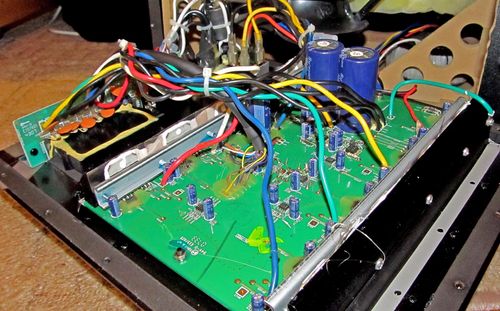
Electrolytic capacitors:
They play a very important function in sound quality, information technology'southward astonishing how the sound changes by different brands and types. The stock Su'scon caps (Tbor in a newer versions) made for general purposes, not for audio and as a brand, they already have a poor reputation. In this situation we are not to worry almost durability, much more concerned virtually how it performs in audio. Alternatives are many and I advise to become for the High-End audio grade capacitors to achieve the most impressive result. Otherwise what is the benefit to alter them?
From the bigger PSU caps price comparing gives an idea. Common merely not a dominion in the audio world, the bigger size caps are superior.
When choosing capacitors it's important not to go under the original voltage rating. Using higher is amend because the lower ESR and durability. Unfortunately they toll more and have upwardly more than space and the benefit is arguable. Many audio grade capacitors are almost twice every bit big every bit a standard! Sometimes it's more than practical to buy (like I did) higher voltage capacitors, instead of hunting for dissimilar voltages and pay the actress for shipping after the many purchases.
These pages contains descriptions about sound grade electrolytic capacitors:
http://tech.juaneda.com/en/articles/electrolyticcapacitors.html
http://www.head-fi.org/t/528380/electrolytic-capacitors-used-in-sound-dc-blocking-comparison-tread
PreAmp panel:
As nosotros tin see, it contains ceramic capacitors and they are non bang-up for audio in full general. Maybe they are impressive in some ways, only for those who spent time to examine how they are behave in audio circuits are avoid them.
http://world wide web.reliablecapacitors.com/pickcap.htm
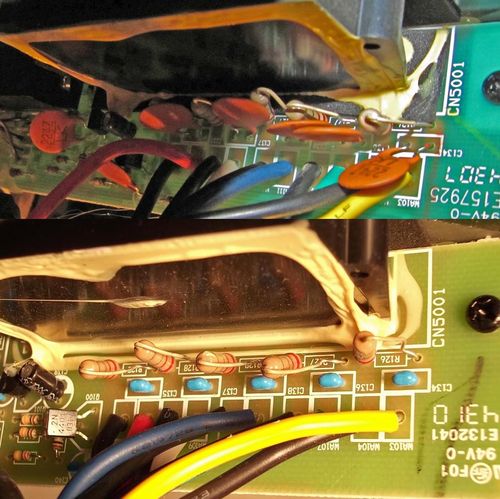
I approximate Logitech also had the aforementioned feeling and moved towards the C0G/NP0 ceramic in a later version, those aren't equally bad for audio.
Polystyrene is one of the best and possibly a difficult to get alternative, loved past the fans of tube amplifiers.
http://world wide web.radio-electronics.com/info/data/capacitor/polystyrene-film-capacitor.php
Wima MKP, MKS capacitors take a good reputation for audio and are relative like shooting fish in a barrel to find.
This is not a chiliad€ system, then in that location's no signal to go mad and buy fancy, expensive moving picture capacitors for this position.
Speakers:
A vital part. Perhaps the best upgrade you tin do with the original satelites to utilise cotton fiber to fill up up the boxes, simply non also thigtly.
Here you tin find a good comparing on how the original satelites perform agains more expensive speakers:
Speaker wires:
I haven't paid much attention for wires for a long time, until I got my experience with a curt jack extension lead, and got me surprised how bad the sound turned out to be. My first idea was, there'due south problem with the contact than I realised it's not at all.
I don't think you volition be further away with some cheap wire from the supermarket, or worth every penny to spend on someting expensive. There are people who swear solid core wires are a footstep forward over stranded wires and perchance you lot tin can try out coax or other copper cablevision if you lot have any arround. Thick core is preferable.
Peradventure you will notice this intresting nearly cables:
http://www.audioholics.com/education/cables/cable-baloney-and-dielectric-biasing-debunked
The starting time Mod
No thing how much I prepared , I had to rely on the local tools for the get-go project and it certainly made things dull for me, yet proven to be enough to have the standard equipment to complete the whole process.

This system had already seen modification, since the possessor started to use five of the JBL SCS178 Home Cinema speakers years ago, and they became more than beneficial after the upgrade. Certainly ane of the primary disadvantages of the many.1 sound systems are the lot of modest speakers without the ability to embrace the full sound spectrum.
With some solid copper wire left from the rewiring task in the flat, I had an idea to use it to supplant the originals.
The OpAmps are the easiest and logical targets for the start, and practice non require to have out the whole PCB of the amplifier part like the recapping. Doing the job step past step is the recommended mode, fifty-fifty if it bores you a bit to practise it so many times. At least when you have a problem, you take an idea where to look during the upgrade. One or two spare OpAmp is proficient to have just in case if one of them is faulty and you don't want to wait days to get another.

Here the original soldering isn't giving a headache, the complications are the wires and the bully amount of glue over the parts on the PCB. Information technology also covers minor SMD components or the wires of the ferrite beads. So just be extremely careful with cutting tools! Instead attempt to mechanically remove them outset where it's like shooting fish in a barrel, than in the critical areas use a hair dryer to melt the stuff, or (what I don't like) the with the soldering iron. So you lot will really offset to beloved the steel scrubber!
The new caps take upwards more infinite and have more weight too, so don't forget that this is a Subwoofer, abiding vibrations are expected, and the long length of capacitor legs are not a good idea. When your tests are washed I propose to apply glue gun to stabilise them.

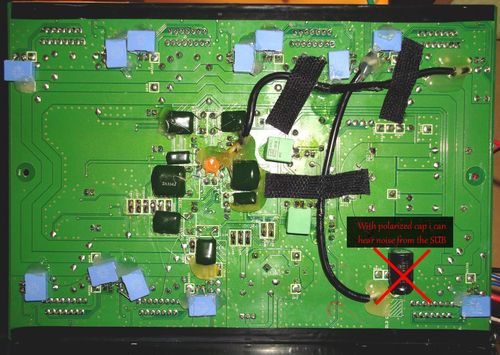
On the bottom of the amplifier PCB there is one NP (not polarised) 100uF 10V capacitor. Considering the polarity is marked on the panel, I decided to requite it a try with a polarised, same valued cap. I had to modify it back because it resulted in some abiding racket from the SUB.
For the filter capacitors of the amplifier board I have decided to use a combination of more dissimilar value caps in parallel instead of only two. It is non necessarily a well paid out investment, and is a pocket-size benefit by and large for the bass.
In general, recommended to utilise the same type of capacitors, or increasingly amend quality towards to the smaller values to avert generating noises. There are too many suggested ratios, and I just don't know what provides the best results.
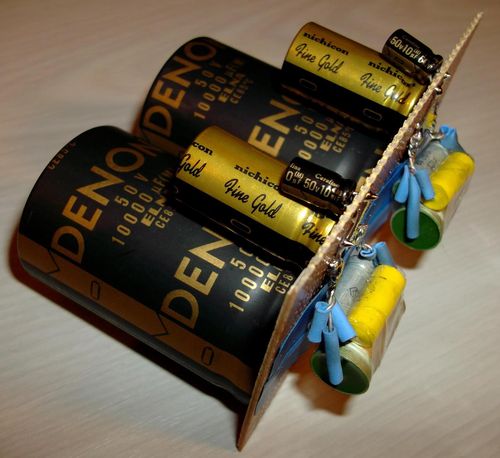
The sizes of my new Elna DENONs are almost double of the old residents, so the simple replacement fell out of the choices. On the photo, with the help of a prototyping matrix board I've improved the stability of the capacitors, and used the glue gun to fix it to the bottom of the box, plus the two big caps got a self adhesive hooks and loops tapes on the dorsum to be sure. If necessary the ends of the wires can get some mucilage to avert breaking from vibration in the future. I bet someone thinks using wires as I did isn' the best or even outrageous, only I rather accept them this style instead keeping the original c(r)aps. In the next mod I came up with a meliorate solution.
When I reached the control panel I didn't accept enough capacitors left to upgrade the analog office. My original idea was to build a new, simplified control panel, because I dear minimalistic design on the signal path, then I didn't pay much attending for the circuits of the control panel in the beginning. Then the program took other direction, and I have inverse 3 OpAmps on the analog input, and unfortunately the finish of my holiday trip stopped me to experiment further this time.

I'm sure many people accept noticed the rut generated past the fries in the control panel. I saw a smoky one somewhere on the Cyberspace, so to utilise a few heat sinks (made for RAM) over the bigger fries are not doing any damage. Just because they tolerate rut well not necessarily mean they dear information technology likewise in the long term, peculiarly in the summer in some countries.
I had a mixed feeling to change the main capacitor of the command console, because it take both analog and digital circuits, and the controlling electronics not ever love lower ESR caps. The audio system doesn't remember some of the settings after a complete power off. This is non entirely new according to the owner, then I tin't be entirely certain it is related. He developed quick addiction to the new sound of the Z-5500 and non supported my idea to return to the old capacitor. Days later, subsequently the proper burn-in period he reported this little complexity take vanished once again.

Examining the upshot of the upgrade step by step:
it isn't require special predictions what to look from an upgrade like this, if yous have done something like. This sound system isn' mine and the owner knows its sound very much, and then it was the appropriate choice to use his help to determine what is inverse.
Beginning, the new speaker wires and the polystyrene capacitors resulted in more than details in the high range.
New OpAmps for the speakers in the subwoofer box gives y'all more resolution and clarity, the guitars becoming alive. Now the new dimension for the further upgrade is open up.
Past the change of the two OpAmps belonging to the SUB, the days of the "big vibrator" is over, the bass is fast and accurate, integrated in the rest of the audio, not continuing out.
After the change of the capacitors on the amplifier console the dynamic, alive audio appeared, the low range sounds improved, the feeling of soundstages is impressive.
The master filter capacitors give some more free energy and refinement for the sound, at present the bass hits perfectly.
Finally, the change the three OpAmps belong to the analog inputs resulted in some more pocket-sized improvement in every level.
I have to say that the sound became much closer to that what y'all tin wait from a good quality speaker organisation. The guitar sound as a guitar, cymbal clashes non crushes, the drums don't just shake the glass out of the window and so on.
The 2d Modern
I spent only the third of the time thanks to the gained experience and well equipped home environs. Here I chose mostly Nichicon KZ, KG capacitors, considering this system have the original speakers, and equally I remember people are complained well-nigh the poor midrange and that is exactly one of the beautiful strenght of the Nichicon capacitors. The other reason was to have fun with a different sound. Either way if you chose from the High-End audio grade capacitors, - fifty-fifty mixing types, it'southward 1 of the brands you can't become incorrect with, especially without previous feel of their audio signature - y'all will love them for certain.
Hither I have inverse the capacitors too on the analog input, than weeks later the owner brought me back the arrangement to change the remaining three OpAmps on the analog Output and three more than caps effectually the volume control bit.

In the second mod i had a better solution to install the filter capacitors, closer to the original positions. I have carefully drilled holes on the PCB and used plastic hex spacers and plastic screws to avoid creating short circuit betwixt the 2 sides. The wires should be cutted back equally short as possible. From the lesser of the PCB i have removed all the SMD capacitors, because a few of them accept been burnt out by unknow reason (chip early for a year erstwhile System) and after the multiple filter capacitors there's no point in keeping them.
This system had the original speakers and no doubt they take plenty reserve left to perform pretty adept with the new setup. The replacement of them is certainly beneficial but not essential.
The owner of this Z-5500 (later the commencement day of listening) told me, he loved the rich experience of the new audio. Now the music has body, he found the high-mid as beautiful, and only noticed that maybe the Sub have less dominance on the same settings but only on low volume. He used his previously modded XtremeMusic carte du jour for a few days than tried an SB Titanium what I had modified for somebody else and gave him for a tryout. My phone rang shorty and deluded by the sound he said: "Tell your men he volition Non go this menu!"
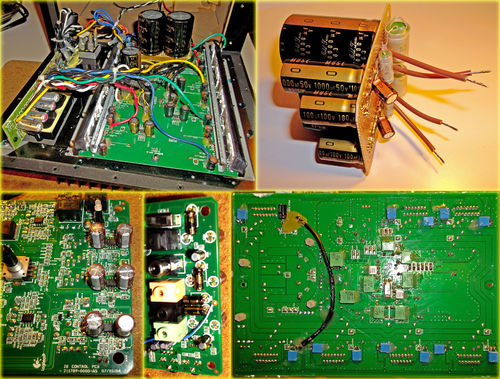
The tertiary Modern
Really information technology'south more the twelfth. I Got lucky and found a lot of broken amplifier boards and I couldn't resist to have more fun and likewise looked forward to the opportunity to learn how to repair broken Amps. Since the beginning I was wondering what's the real use of the OpAmps in the subwoofer, because at that place are 3 of them afterwards the DACs in the pod on the signal path already, and as an audiophile I like to avoid annihilation unnecessary. As far as I know no schematic is bachelor for the organisation, so I started tracing back the way of copper on the boards, removing, measuring components checking datasheets, do all the necessary reverse engineering science. So every bit a determination i decided to leave 3 OpAmps completely out of business. Replacing them with 0.47uF motion-picture show capacitor making the audio clearer than any OpAmps in the same position and no decrease of the book, or undesired side effects. It too means less stress on the voltage regulators and the other OpAmps do good from the more stable free energy. Worth to mention, easy to do and costs virtually ten€ less.

For the surround all 6 electrolytic capacitors completely removed the SMD components included. Equally y'all see on the photos only the 2 OpAmps and 4 caps for the Sub are inverse and the belonging SMD components remain untouched. Exist careful if the copper pads coming off or get loose, because it'south easy to crusade a hidden short circuit with the remains. I was using foam like tape, sticking to sides under the 0.47uF capacitor and afterwards a few drops of epoxy on the corners, than I connected them to the jumper wires on the input of the TDA Amps and on the other end I cut off the gum virtually the incoming wires and used the copper on the surface to solder. Looking on the pictures it is obvious, but what yous cannot encounter is that I also removed five small ceramic SMD capacitors on the point path and continued the 2 pads. More precisely the C100, C200, C300, C400, C500. From capacitors I suggest to pick something proper for audio, and the circular shaped axial films are a handy option indeed. Avoid tantalum or ceramic.

WA83 Yellow & Black --to-- JP406 Rear Left
WA81 Dark-brown --to-- JP206 Rear Correct
WA80 Blue --to-- JP106 Center
WA82 Purple --to-- JP306 Front end Right
WA85 Grey --xx-- Sub
WA84 Yellow --to-- JP506 Front Left
Technically the residuum of the modification is identical to the previous one.
I accept not mentioned earlier the effect if you solder the 0.22uF 63V picture capacitors (the blueish boxes) in parallel to the pins of the electrolytic capacitors (belonging to the TDA amps). The sound becamemore clean and free flow, really it's a nice add-on.
For this system I used generally ElnaSilmic II and for the filters ElnaFor Audio capacitors and a Nichicon KA for the pod what is new grade the company. I got rid of the the NP 100uF 10V capacitor and used Nichicon ES. The sound of this setup is actually up to my taste. Clean, soft, warm, rich and the bass is powerfull, going deep, hitting hard, and detailed. If you have walls to interruption, this is the way.

Later on the modding:
The audiograde electrolytic capacitors have a burn down-in period. Depending on type and brand you are using information technology may appear a bit harsh, booming, distorted etc. and clearing off later some active use and becoming overnice clean and warm. About of the improvement can exist expected in the offset 5 days, and some more than refinement later. The possessor of the first organization experienced improvement up until two months after the complete mod.
I'm a bit sceptical well-nigh the sensible effect of the burn-in period for Operation Amplifiers.
Maybe sometimes you will leave your favourite sound system disconnected for a period when you are away, and after that you volition probably notice a difference in the sound. One 60 minutes of running will bring it back to normal, the musicians allow run their equipment for hours before concerts for a proficient reason.
Some interesting links about the Z-5500:
Z-5500 VS Z906
http://soundnews.ro/2011/05/29/logitech-z906-review-english-version/
[MOD]Z-5500 Rewiring satellites
http://www.overclock.cyberspace/t/211128/mod-z-5500-rewiring-satellites
I would like to thank to Narasim and Kanmouse to permit me experiment on their love audio systems and took the adventure of an amateur, enthusiast modder. And for Nyunyu to assist me with the smaller, but tricky parts of the beginning mod.
FAQ:
What part of the modern is the best bang for the coin?
OpAmps twoscore% (special in the SUB)
22uF & 47uF capacitors in the SUB 30%
The two main filter capacitors 15%
The rest 15%
Practise you know whatever webshop to buy all the components in one identify?
I practise not. I gave up looking for it long ago.
My Z-5500 looks completely different inside than on your photos. Why?
The Logitech Z-5500 has iii versions (inside) and components are more than or less the same, then the mod should work.
I have a Logitech Z-XXXX speaker system, tin I do something similar?
Commonly you tin.
Tin I do some modification like this in a different brand speaker arrangement?
Basically yes. Irresolute components to something amend is non a new revolutionary idea or discovery to improve the sound. Of class a lot depends on the pattern how far you lot can go. For example a printed circuit board full of tiny SMD components gives yous only limited options. OpAmps are an platonic target for a start.
What soundcard y'all recommend for the system after a full mod?
The all-time choice is a soundcard with audio grade capacitors with swappable OpAmps, or a modified SB X-Fi Titanium can push button the system to its limits.
Hither you can detect how to practise it.
http://www.head-fi.org/t/589078/almis-x-fi-mod-hotrodding-sound-equalizer-10-fi-models
What ratio yous used to build the filter capacitors?
In the second mod x:ane, so it ways 10000uF-1000uF-100uF-10uF-1uF-0,1uF.
What is the improve, to upgrade or buy a newer Logitech speaker organisation?
The newer model may take the chance to contain more advanced design and fundamental components, and offer benefit over the older blood brother.
This onetime model upgraded with High-Cease components is offering something special what you volition not detect at all in this price range.
I'g interested in upgrading my Z-5500, simply I do not have the skill. Where should I start looking for to find somebody to do the job for me?
I accept merely a few ideas to showtime: People who repair household electronic equipments like Radio, Tv set, electronic component, computer or mobile phone shops. Places to buy/rent instruments or sound equipments. Ask your friends, relatives.
The fuses constantly blow afterward some modification, only everything seems to be ok. What could be the reason?
Can be many reason like: reversed polarity of a capacitor, misplaced mica insulation between amps and heat sinks, not proper fuse (the original is 2A ho-hum blow), short circuit caused during soldering on the PCB, faulty or damaged component(s), new cap damaged past too long screw etc.
How can I fix damage on the PCB?
Delight check my other thread for the answer under "Fix for damaged PCB".
http://www.head-fi.org/t/589078/almis-x-fi-mod-hotrodding-audio-equalizer-x-fi-models
I take Z-5500 with broken command panel, is at that place any workaround to brand the system work without?
Yes, a cable exists to make the system work without the control panel. You can get in or yous can discover it on eBay.
http://world wide web.ebay.ie/itm/Logitech-Z-5...=US_Audio_Cables_Adapters&hash=item4ab3465340
http://www.diyaudio.com/forums/chip-amps/110310-hacking-logitech-z5500.html
I take a trouble with subwoofer Hum whatever idea what'due south causing it?
This thread might take some useful data.
http://www.neoseeker.com/forums/1/t501181-logitech-5500-subwoofer-hum/
If you need I'll effort to assistance, according to my skill and time: ramachandra@citromail.hu

How To Fix Fuse In Z-5500 Digital Logitech Without The That Screws On Fuse,
Source: https://www.head-fi.org/threads/almis-logitech-z-5500-mod-high-end-upgrade-for-the-speaker-system.657715/
Posted by: lemendessaimis35.blogspot.com
0 Response to "How To Fix Fuse In Z-5500 Digital Logitech Without The That Screws On Fuse"
Post a Comment